
Yiruida news
What Are Layered Foam Strips? A Practical Guide to Construction, Performance, and Applications
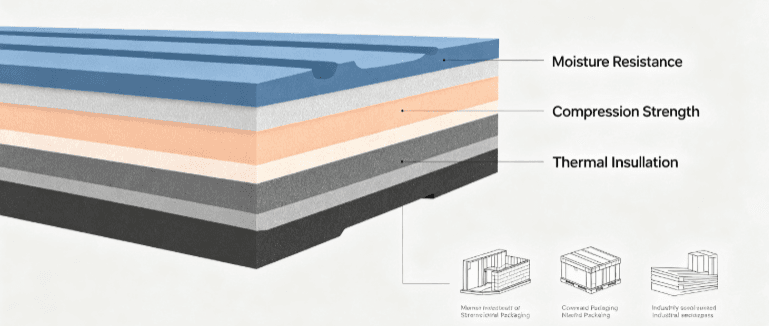
If you’ve ever handled a strip of foam that felt different on one side than the other—maybe firm on the bottom, soft on the top, or with a peel-and-stick backing—you’ve already met a layered foam strip. These products are everywhere in industrial packaging, electronics, automotive sealing, and construction. Yet most people who specify or buy them never really think about how they’re made or why the layers matter. They just know the strip works.
But when you’re the one responsible for choosing the right material, a little knowledge goes a long way. Layered foam strips are not one product. They’re a family of engineered composites, and the difference between a good one and a bad one often shows up in the field, not on the spec sheet.
This guide is for engineers, buyers, and production folks who need to understand what layered foam strips actually are, how they’re built, where they’re used, and what separates a reliable strip from a cheap imitation. I’ll keep it practical. No fluff.
1. Defining Layered Foam Strips
Let’s start with the obvious question: what exactly is a layered foam strip?
A layered foam strip is a continuous length of foam material composed of two or more distinct foam layers bonded together. Each layer has a specific density, thickness, chemical composition, or surface treatment. The layers work together to provide a combination of properties that a single-layer foam cannot easily deliver. For example, you might have a soft, conformable layer for gap filling on top, and a firm, closed-cell layer underneath for structural support and moisture resistance.
The term “layered” can also refer to an adhesive layer, a film layer, or a fabric facing. In many cases, the strip includes a pressure-sensitive adhesive backing protected by a release liner, making it easy to apply during assembly. The layering concept is flexible—pun intended—and manufacturers use it to solve specific design problems.
A lot of confusion comes from the fact that “layered foam strips” is a descriptive term, not a standardized product category. There’s no single ASTM spec that defines exactly what a layered foam strip must be. Instead, you’ll find relevant test methods for the individual foam layers and for the finished assembly. I’ll get to those in a bit.
2. How Layered Foam Strips Are Made
The manufacturing process for layered foam strips varies depending on the materials and the intended application. But the core steps are fairly consistent across the industry.
Step 1: Foam Production
Each foam layer starts as a slab or bun, produced either by pouring liquid chemicals into a mold (for polyurethane) or by extruding thermoplastic resin (for polyethylene, EVA, or PVC). The foam is then cured, cooled, and often slit into thinner sheets.
Step 2: Lamination
The layers are bonded together. This can be done with adhesive films, liquid adhesives, or heat lamination. The choice depends on the foam chemistry and the required bond strength. For high-performance applications, manufacturers use pressure-sensitive adhesives or reactive hot melts that will not fail under temperature cycling.
Step 3: Slitting and Die Cutting
Once the layered sheet is formed, it is slit into narrow strips of the desired width. A single master roll might be 60 inches wide, then slit into hundreds of strips, each 1/4 inch, 1/2 inch, or custom width. Precision slitting is critical because edge quality affects how the strip seats in a groove or against a surface.
Step 4: Adhesive Application (Optional)
If the strip requires a mounting adhesive, a transfer adhesive or double-coated tape is laminated to one side. The adhesive is usually covered with a release liner, often silicone-coated paper or film, which is peeled away during installation.
Step 5: Winding and Packaging
The finished strips are wound onto spools or coils, then packaged for shipment. Some products are cut to specific lengths and shipped flat, but spools are more common for continuous sealing applications.
The quality of a layered foam strip depends heavily on two things: the consistency of the foam layers themselves and the reliability of the lamination bond. A weak bond will cause the layers to separate under shear or repeated compression. That’s a failure you don’t want to discover on a customer’s production line.
3. Why Layers Matter: The Performance Logic
Why go to the trouble of layering foams instead of using a single material? Because different functions demand different properties, and no single foam does everything well.
Take a typical weather-stripping application. The foam strip needs to compress easily to fill the gap, but it also needs to resist compression set over time, repel water, and maybe provide some thermal insulation. A single open-cell polyurethane foam might compress easily, but it absorbs water and breaks down under UV. A closed-cell PVC foam might resist water, but it’s too firm to conform to irregular gaps.
The solution: combine a soft, open-cell layer for conformability with a closed-cell layer for moisture resistance. The layers work as a system, each doing what it does best.
The same logic applies in electronics. A display gasket might need a soft foam layer to absorb impact and a conductive fabric layer to provide EMI shielding. Layering allows you to stack properties vertically, without sacrificing the strip’s compact cross-section.
In my experience, the most important thing is to think about the strip as an assembly, not just a material. The interface between layers is where failures usually start. A well-designed layered foam strip will have a bond that is stronger than the foam itself—so the foam tears before the layers peel apart. If the bond is weaker, you’ll see delamination.
4. Common Foam Materials Used in Layered Strips
The choice of foam materials determines most of the strip’s performance. Here are the ones you’ll encounter most often.
Polyurethane (PU) Foam
Available in open-cell and closed-cell forms, in a huge range of densities from 15 kg/m³ to over 200 kg/m³. Open-cell PU is soft, conformable, and good for cushioning. Closed-cell PU offers better moisture resistance and structural integrity. PU is the workhorse of the foam strip industry.
Polyethylene (PE) Foam
A closed-cell thermoplastic foam, typically available in densities from 20 to 100 kg/m³. PE is lightweight, chemical-resistant, and has excellent water resistance. It’s often used for gaskets, spacers, and protective strips. The surface is smooth and accepts adhesives well.
EVA (Ethylene-Vinyl Acetate) Foam
EVA is a closed-cell copolymer foam that is tougher and more rubber-like than PE. It has good recovery, good shock absorption, and can be produced in a wide range of colors. It’s common in sports equipment, footwear, and industrial padding.
Silicone Foam
For high-temperature applications, silicone foam is the go-to. It can handle continuous temperatures up to 200°C and higher, depending on grade. Silicone foam is often used in automotive gaskets, aerospace, and medical devices. It’s more expensive but durable.
Vinyl (PVC) Foam
Closed-cell PVC foam is weather-resistant and has good compression-set resistance. It’s commonly used in window seals, door seals, and marine applications. Some PVC foams contain plasticizers that can leach over time, so material selection matters.
Nitrile and Neoprene Foam
These are elastomeric foams with good oil and fuel resistance. Neoprene is common in HVAC and refrigeration applications. Nitrile is used where petroleum products are present.
Each of these can be layered with others. A common combination is a PE foam core with a PU foam face, or a silicone foam with an acrylic adhesive layer. The possibilities are extensive, which is why working with a knowledgeable converter is valuable.
5. Key Properties and How to Test Them
When you’re comparing layered foam strips, you need to look beyond the data sheet and understand what the numbers actually tell you. Here are the properties that matter most.
Property | Standard Test Method | What It Tells You |
Density | ASTM D3574 or ISO 845 | Mass per unit volume; affects firmness and cost |
Compression deflection (firmness) | ASTM D3574 Test C or ISO 3386 | Force required to compress the foam a given percentage |
Compression set | ASTM D3574 Test D or ISO 1856 | How much the foam permanently deforms after compression |
Tensile strength and elongation | ASTM D3574 Test E or ISO 1798 | Resistance to tearing and stretching |
Peel adhesion (for layered bond) | ASTM D903 or ASTM D1876 | Strength of the adhesive bond between layers or to substrate |
Water absorption | ASTM D570 (for closed-cell) | How much water the foam takes up; lower is better for sealing |
Temperature resistance | Manufacturer test | Service temperature range before degradation |
One thing I always emphasize: compression set is the silent killer. A foam strip that feels soft and seals well initially can take a permanent set after a few weeks of compression, leaving a gap that was supposed to be sealed. If your application involves long-term compression, look for a foam with low compression set—ideally under 10% after 24 hours at 70°C, per ISO 1856.
Adhesion is the other failure point. I’ve seen cases where the foam itself was perfect, but the adhesive backing released from a powder-coated surface after six months. Before committing to a strip, do a real-world adhesion test on the actual substrate—not just a lab coupon.
6. Typical Applications Across Industries
Layered foam strips show up in more places than most people realize. Here’s a quick tour.
Automotive
Door seals, hood seals, anti-rattle strips, dashboard gap fillers, and vibration dampers. These strips often combine a soft PU layer for conformability with a closed-cell layer for weather resistance.
Electronics and Appliances
Display gaskets, EMI shielding strips, dust seals for printers, and cushioning strips inside shipping packages. In consumer electronics, layered foam strips are used to protect screens during assembly and to seal enclosures against dust.
Construction and Building
Window and door weatherstripping, expansion joint fillers, and acoustic seals. Many of these are adhesive-backed for quick installation and are designed to last for 10 years or more.
Packaging
Protective strips inside rigid boxes, cushioning for delicate components, and edge protectors. In packaging, the layered structure allows a soft inner layer to contact the product while a firmer outer layer resists impact.
Medical
Padding for orthopedic devices, gaskets for medical equipment, and cushioning in diagnostic instruments. Medical-grade foams must meet biocompatibility standards, so material selection is stricter.
Industrial Equipment
Vibration isolation pads, gaskets for enclosures, and seal strips for access doors. Heavy equipment uses thicker, denser foam layers that can withstand repeated compression and harsh environments.
The trend I’ve noticed is toward more customization. Instead of buying a standard foam tape off the shelf, more companies are working with converters to build a strip with exactly the layers they need. That’s where the real value is.
7. A Real-World Example: Vibration Damping in Electronics
Let me share an example that’s not from any single company’s press release, but from the kind of project you see in electronics manufacturing all the time.
A manufacturer of portable ultrasound machines was experiencing early failures in a display assembly. The LCD panel was mounted against a metal housing with a simple foam pad. The pad compressed over time, allowing the panel to contact the housing and creating stress points. Also, the foam didn’t provide enough vibration isolation during shipping, leading to cracked panels.
The solution was a layered foam strip composed of three layers: a soft microcellular PU foam on top to cushion the display, a firmer closed-cell PE foam underneath to provide a stable base, and a high-bond acrylic adhesive on the bottom for permanent mounting. The strip was die-cut to match the panel outline, eliminating the need for manual placement of individual pads.
The result, as measured by the manufacturer’s in-house testing, was a significant reduction in panel failures during drop testing and transit. The company also reported easier assembly because the strips came on a roll with a release liner, ready to apply.
I’m not going to claim this is a unique story—it’s the kind of problem that layered foam strips solve every day. The lesson is that a simple pad often isn’t enough. Layering allows you to tune the performance precisely without adding bulk.
8. Frequently Asked Questions
What is the difference between layered foam strips and single-layer foam strips?
A single-layer foam strip uses one foam material, so it offers one set of properties. A layered strip combines two or more foams, or a foam with adhesive or film, to achieve multiple functions—like soft cushioning on one side and firm structural support on the other.
Can layered foam strips be made to custom widths and thicknesses?
Yes. Most converters can slit strips to widths from 1/16 inch up to several inches, and overall thickness can range from under 1 mm to over 25 mm. Custom die-cut shapes are also common.
How do I choose the right adhesive for a layered foam strip?
The adhesive depends on the substrate and the environment. Acrylic adhesives work well on metals, glass, and high-surface-energy plastics. For low-surface-energy plastics like polyethylene or polypropylene, a silicone-based adhesive may be needed. Always test on the actual substrate.
Are layered foam strips recyclable?
It depends on the materials. Mixed-material laminates are difficult to recycle because the layers cannot be easily separated. Some manufacturers offer mono-material foam strips with compatible adhesives, which are more recycling-friendly. If sustainability is a priority, discuss options with your supplier.
What is the typical shelf life of a layered foam strip?
Most foam products have a shelf life of 12 to 24 months from the date of manufacture, provided they are stored in a cool, dry environment away from direct sunlight. Adhesive performance can degrade over time, so it’s best to use within the stated period.
9. Final Thoughts
Layered foam strips are one of those quiet, unglamorous products that make modern products work. They seal, cushion, damp, and protect—usually out of sight. But when they fail, everyone notices.
If you’re specifying or buying these strips, take the time to understand the layers. Ask your supplier what each layer is made of, why it was chosen, and how the bond is tested. Look at compression set and adhesion data. Do a practical test in your actual application. The small effort upfront will save you from headaches later.
And don’t be afraid to ask for a custom solution. A standard strip might be cheaper on paper, but a well-designed layered strip that solves a specific problem will often pay for itself many times over in reduced failures and fewer assembly headaches.
Project discussion