
Yiruida news
EPE vs EVA vs PU Foam: How to Choose the Right Protective Packaging Material
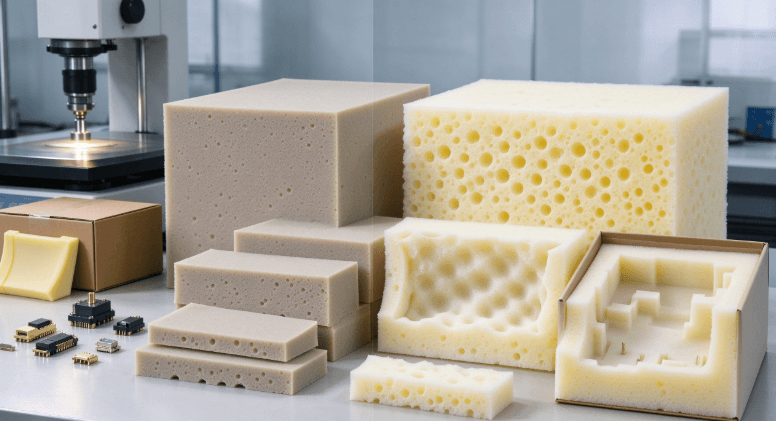
I've spent more than fifteen years specifying foam packaging for electronics manufacturers, medical device companies, and industrial equipment suppliers. And I can tell you with absolute confidence that the single most common mistake I see is not choosing the wrong foam. It's choosing the wrong foam for the application because the buyer never asked what the product actually needed.
The global foam protective packaging market was valued at USD 13.15 billion in 2025 and is projected to reach USD 20.68 billion by 2034, growing at a 5.27% CAGR. That's an enormous volume of material moving through supply chains. And a significant portion of it is either over-specified—paying for performance you don't need—or under-specified—saving money now and paying for it in damage claims later.
The three materials at the center of most B2B sourcing decisions are EPE, EVA, and PU foam. They look similar in a sample box. They behave nothing alike in the field. This guide is about understanding the difference and matching the material to the application.
The Fundamental Differences in Behavior
Each of these foams handles impact energy in a fundamentally different way. Understanding that behavior is the key to selecting the right one.
EPE (Expanded Polyethylene) has a wide plateau stress region. In plain terms, that means it maintains a relatively constant load-bearing capacity across a broad range of compression. It absorbs moderate-energy impacts well and recovers most of its shape after compression. The recovery rate for quality EPE is typically around 98%. It's lightweight, moisture-resistant, and the most economical of the three. The limitation is that EPE stiffens at low temperatures—below roughly -10°C, it becomes less effective at absorbing impact.
EVA (Ethylene Vinyl Acetate) has a higher initial stiffness. It develops high load-bearing capacity at low strain, which makes it better suited for high-energy impacts. The cell structure is closed, meaning it doesn't absorb water and provides excellent moisture resistance. EVA is denser than EPE—typically 35 to 60 kg/m³ compared to EPE's 20 to 40 kg/m³—and the impact resistance is roughly 40% higher than EPE for equivalent thickness. The tradeoff is weight and cost.
PU (Polyurethane) foam has progressive compression characteristics. Its load-bearing capacity increases gradually as strain increases, which makes it ideal for delicate products that need gentle, progressive deceleration rather than a hard stop. PU foam is softer and more flexible than polyethylene foams, and it provides excellent cushioning against vibration and small impacts. The open-cell structure of standard PU foam means it can absorb moisture, which is a limitation in humid environments.
Property | EPE (Expanded Polyethylene) | EVA (Ethylene Vinyl Acetate) | PU (Polyurethane) |
Density (kg/m³) | 20–40 | 35–60 | 8–15 |
Impact Behavior | Moderate energy, wide plateau | High energy, high initial stiffness | Progressive compression, vibration damping |
Moisture Resistance | Good (closed cell) | Excellent (closed cell) | Poor (open cell) |
Low-Temp Performance | Degrades below -10°C | Better than EPE | Moderate |
Relative Cost | Lowest | 40–60% higher than EPE | Variable |
Best For | Light electronics, general cushioning | Precision instruments, high-value items | Delicate electronics, optical components |
EPE: The Volume Workhorse
EPE is what most people picture when they think of foam packaging. It's the white or pink sheet material that wraps around electronics, the custom-cut inserts in a shipping box, the cushioning layer under a fragile item.
It works because it's predictable. The compression set for quality EPE is typically under 10%, meaning it recovers its thickness after repeated compression cycles. That matters for products that will be handled multiple times during distribution—the foam needs to keep protecting the product after the third or fourth repack.
EPE is also the most cost-effective option. For high-volume consumer electronics, small appliances, and any product where the impact energy is moderate and the weight is under roughly 5 kg, EPE is almost always the right choice. It's also recyclable as LDPE, which matters for brands with sustainability commitments.
The limitation I see most often is underspecification. A buyer specifies 20mm of EPE for a product that really needs 40mm, because the 20mm sample "looked fine." Then the first shipment goes out, the box gets dropped from a conveyor, and the product arrives cracked. EPE works, but only if the thickness and density are matched to the actual impact energy.
EVA: The Precision Protector
EVA is what you specify when the product is expensive enough that damage claims would hurt more than the material cost. Digital cameras, precision instruments, medical devices, optical equipment. These are applications where the impact energy is high and the tolerance for damage is zero.
The higher density and closed-cell structure of EVA give it better energy absorption at high impact velocities. It also provides better compression recovery under sustained load, which matters for products that will be stored in the packaging for extended periods before unboxing. EVA is water-resistant, UV-resistant, and resists chemicals and oils.
The cost is significantly higher than EPE—roughly 40% to 60% more per unit for equivalent dimensions. But for a product that costs hundreds or thousands of dollars, the material cost difference is negligible compared to the risk of a damage claim, a lost customer, or a warranty return.
One additional advantage: EVA can be formulated for anti-static applications. For sensitive electronic components—PCBs, semiconductors, computer chips—anti-static EVA foam prevents electrostatic discharge damage during shipping and handling. That's a functional requirement that standard EPE cannot meet.
PU: The Gentle Giant
PU foam occupies a different niche entirely. Its progressive compression curve means it doesn't deliver a hard stop. It decelerates the product gradually, which is exactly what you want for delicate items with low mass and high fragility.
Think of a precision optical instrument. It's lightweight. It can't tolerate a sudden shock. PU foam absorbs the impact progressively, spreading the deceleration over a longer time period. That reduces the peak G-force transmitted to the product.
PU is also available in a foam-in-place format. The foam is dispensed as liquid into the box, expands around the product, and cures in place. This creates a custom-fit cushion that conforms to any geometry without the need for tooling or die-cutting. The global foam-in-place packaging market is projected to reach USD 3.34 billion in 2026, growing at 8.56% CAGR through 2032, driven by the need for efficient packaging of irregularly shaped, high-value items.
The tradeoff is the open-cell structure. Standard PU foam absorbs water. For applications in humid environments or involving cold chain logistics, that's a problem. There are closed-cell PU formulations, but they're more expensive. And PU is not biodegradable, which is a growing concern for brands with sustainability mandates.
A Practical Selection Framework
Here's how I frame the decision for clients who are specifying protective foam for the first time.
Start with the product. What's its weight? What's its fragility? What's the maximum impact energy it will experience during distribution? A 2kg product that will be shipped in a single-box parcel to a consumer has very different requirements from a 20kg industrial instrument shipped on a pallet.
Then match the material to the energy. For products under 5kg with moderate fragility, EPE is usually sufficient. For high-value or precision items, EVA is the safer choice. For delicate, lightweight items where progressive deceleration matters, PU is the right answer.
Finally, verify with testing. A drop test per ISTA 2A or ASTM D5276 will tell you more about whether your foam specification actually works than any datasheet. The standard requires packages to be dropped on faces, edges, and corners, simulating the full range of real-world impacts. If your prototype survives that test with the product intact, you've got the right material. If it doesn't, no amount of datasheet reading will fix it.
A Real Case Study: When the Wrong Foam Cost 22%
A consumer electronics brand I worked with was shipping smart home devices in EPE foam inserts. The products weighed about 1.8kg and were moderately fragile. The EPE worked fine for domestic shipments.
Then they expanded into international markets. The products started arriving damaged at a rate of 4.5%. The packaging passed their internal drop test, so they assumed the foam was adequate.
The problem wasn't the foam. It was the distribution environment. International shipments experienced longer transit times, more handling cycles, and more severe temperature variations. The EPE stiffened in cold cargo holds, reducing its cushioning performance. And the vibration during ocean freight caused the products to shift within the insert, eventually compromising the protection.
We reformulated with a composite insert: a honeycomb paperboard structure for rigidity, combined with a thin EVA layer for vibration damping. The total thickness dropped from 50mm to 28mm. Unit packaging cost dropped 22%. Damage rates dropped from 4.5% to 0.8%.
The lesson is simple. The best foam is not the softest or the cheapest. It's the one that matches the actual distribution environment the product will face. Domestic e-commerce and international ocean freight are not the same problem, and treating them as such is how you end up with a 4.5% damage rate.
What to Verify When Sourcing
If you're evaluating a protective foam packaging supplier, don't just ask for a price per sheet. Ask for the density, the compression strength, the compression set, and the recovery rate. These are the parameters that determine performance. A supplier who can't provide them is a supplier who doesn't control their own process.
Ask about their testing capability. Can they run a drop test? Do they have compression testing equipment? A serious manufacturer will have the equipment to validate their own product.
Ask about their fabrication capability. Die-cutting, CNC routing, waterjet cutting, and lamination are all standard processing methods for foam packaging. A supplier with in-house fabrication can produce custom inserts to your exact specifications. A supplier who outsources fabrication adds lead time and reduces quality control.
And ask about anti-static options if you're packaging electronics. Anti-static EVA and PU foam are functional requirements for ESD-sensitive components, not optional upgrades. If the supplier doesn't offer them, they can't serve that market.
Frequently Asked Questions
Can I use EPE foam for electronics shipping?
Yes, for many applications. EPE is suitable for lightweight consumer electronics with moderate fragility. For precision instruments, medical devices, or ESD-sensitive components, EVA or anti-static PU is the better choice.
What's the difference between open-cell and closed-cell foam?
Closed-cell foam (EPE, EVA) has sealed cells that don't absorb water. It provides better moisture resistance and dimensional stability. Open-cell foam (standard PU) has interconnected cells that absorb water. It provides better vibration damping and conforms more readily to complex shapes.
How thick should the foam be for my product?
That depends on the product weight and the drop height it needs to survive. A general starting point is 25mm of EPE for a 2kg product dropped from 1 meter. For heavier or more fragile products, increase the thickness or step up to a higher-density material. Drop testing is the only way to confirm.
Is EVA foam recyclable?
EVA is technically recyclable, but the infrastructure for recycling it is limited. Some bio-based EVA formulations are biodegradable. For brands with strict sustainability requirements, confirm the specific recyclability or compostability of the grade being supplied.
Can I get custom-shaped foam inserts?
Yes. Die-cutting, CNC routing, and waterjet cutting are all standard methods for producing custom foam inserts. The tooling cost for die-cutting is higher upfront but pays back at volume. CNC routing is more economical for low-volume or prototype work.
The Bottom Line
EPE, EVA, and PU foam are not interchangeable. They have different energy absorption behaviors, different moisture resistance, and different cost profiles. The right choice depends on the product weight, fragility, distribution environment, and budget.
Get the specification right. Test it against real-world conditions. And work with a supplier who understands that protective packaging is an engineering decision, not a purchasing decision.
Project discussion