
Yiruida news
Blue Layered Foam Strips: A Technical Buyer's Guide to Construction, Fit, and Verification
A technical deep dive for engineers and procurement teams evaluating blue layered foam strips: how layered construction behaves under load, what to specify, how to inspect incoming lots, and where the format stops being the right choice.
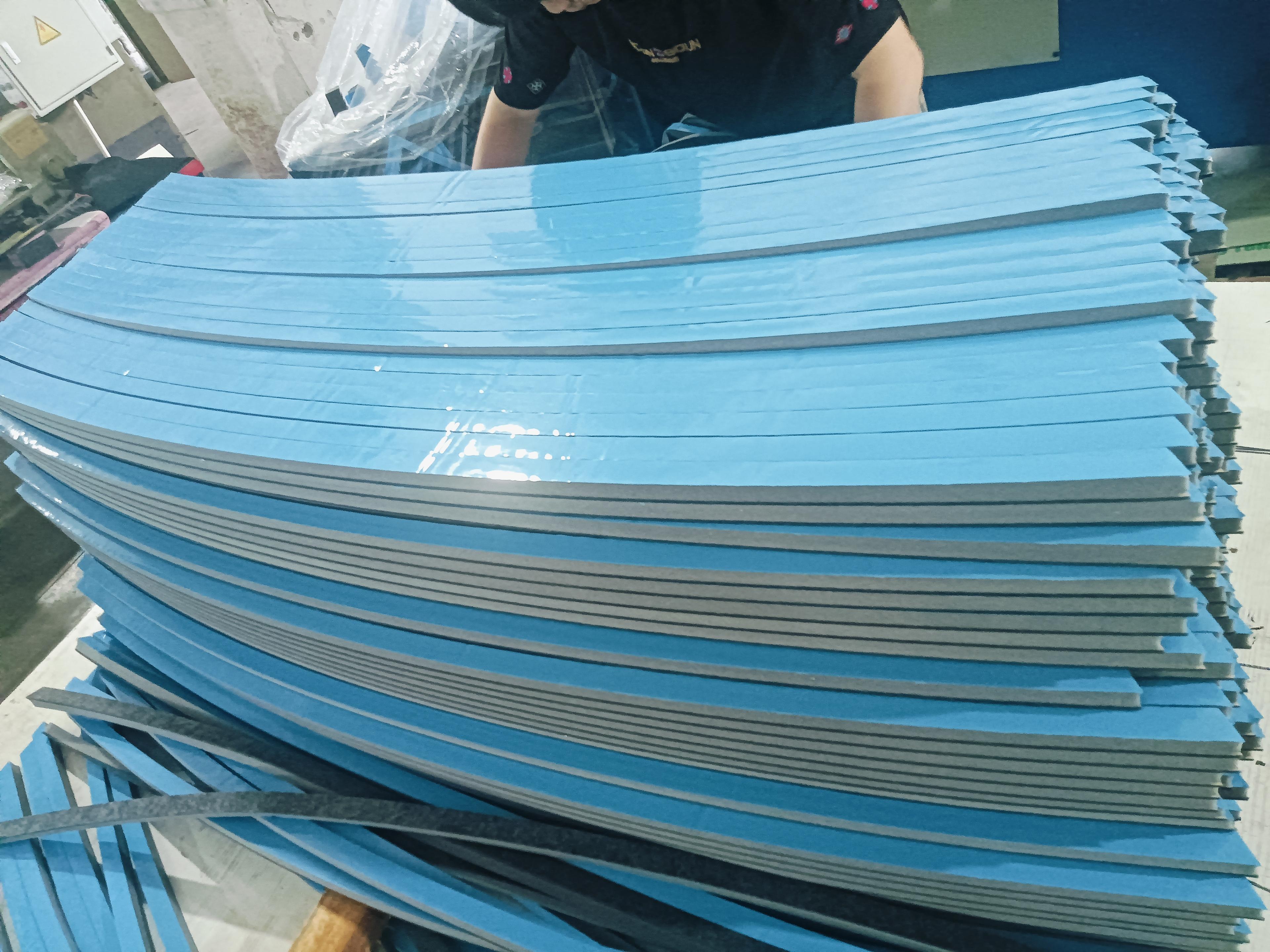
What blue layered foam strips are, and what the format actually does
Blue layered foam strips are narrow, elongated foam components built from more than one foam layer, used inside a packaging assembly to cushion an item, separate adjacent items, or fill a gap between a product and its outer box or insert. The blue color is a visual identifier; it is not a performance specification. Two strips that look identical can behave very differently if the layer stack, density, or thickness tolerance differs.
The layered construction is the part that matters technically. A strip is not a single homogeneous block cut thin. It is a stack, and the interfaces between layers change how the strip compresses, recovers, and distributes load. For a buyer, that means the drawing and the incoming inspection plan have to describe the stack, not just the outline.
This guide covers the mechanism, the specification fields that drive performance, the failure modes to watch, and the verification steps that belong in a purchase order. It is written for engineers and technical procurement teams evaluating foam packaging components, including the layered strip family supplied through yiruidapackaging.com.
How layered construction changes mechanical behavior
A foam strip cushions by deforming. When a packaged item moves, the strip compresses, absorbs part of the kinetic energy, and then recovers so it can do the same job on the next impact. In a layered strip, each layer contributes its own stiffness and recovery, and the bond lines between layers add a third variable.
Layer stack as a design variable
Changing the order of layers changes the strip's response even when total thickness and outer dimensions stay the same. A softer layer facing the product can conform to a curved or finished surface; a firmer layer facing the box wall can resist puncture and spread load. The same two foams in the reverse order behave differently. This is why a purchase order that specifies only "blue foam strip, 10 mm × 20 mm × 500 mm" leaves the most important variable open.
Bond integrity at layer interfaces
The interfaces are where layered strips most often diverge from expectation. If layers are not fully bonded, the strip can delaminate under shear or repeated handling, and the cushioning behavior becomes unpredictable. Delamination is also a cosmetic and contamination risk in clean packaging environments. Buyers should ask how the layers are joined and should include a delamination check in incoming inspection.
Compression set and recovery
Foam that stays compressed after unloading has lost cushioning capacity. Recovery depends on the foam chemistry, density, and how long the strip sat under load in storage or transit. A strip that performs well in a short lab test can still take a permanent set after weeks in a stacked carton. Specify the expected storage and transit duration, and ask for recovery behavior to be confirmed against that duration rather than against a single compression cycle.
Where strips fit in a packaging assembly
Strips are a positioning and gap-filling format, not a cavity format. They are typically used in three roles:
- Cushioning at contact points. Strips placed at corners, edges, or high-mass points absorb impact before the product contacts the outer packaging.
- Separation between items. In multi-unit cartons, strips keep adjacent products from rubbing or striking each other.
- Gap filling and stabilization. Strips take up clearance between a product and a die-cut tray, frame, or box wall so the item cannot shift during handling.
The format choice has consequences. Strips are efficient when the product geometry is irregular, when the packaging layout changes often, or when only part of the assembly needs cushioning. They are a weaker fit when the product needs full perimeter location, because that is the job of a formed cavity. Die-cut white foam trays with formed cavities and die-cut foam gasket frames with repeated openings serve that role; strips and formed inserts are often combined in the same assembly, with the insert locating the product and the strips controlling clearance and impact.
Specification fields that actually control performance
A useful strip specification is a short list of fields that a supplier can confirm and an inspector can measure. The table below separates the fields that drive performance from those that only describe appearance.
| Field | Why it matters | How to state it |
|---|---|---|
| Layer stack (foam type and order) | Controls stiffness, recovery, and surface compatibility | List each layer by foam type and nominal thickness, in order from product side to box side |
| Nominal density per layer | Drives load-bearing and compression set | State a target with a tolerance, and the test method used to confirm it |
| Cross-section dimensions | Determines fit in the assembly | Width and total thickness with tolerances; note which faces are cut and which are skin |
| Length and cut ends | Affects fit and dust generation | Length with tolerance; state whether ends are slit, die-cut, or chamfered |
| Bond method | Controls delamination risk | Name the bonding method and require a delamination check |
| Color | Identification and visual control | State the blue as a reference, and confirm it against a physical sample |
| Cleanliness | Particle and residue risk | State whether cut dust must be removed and how cleanliness is verified |
Color deserves a note. Blue is useful because it is visually distinct from many product finishes and from white foam inserts, which makes stray strip fragments easier to spot during assembly and final inspection. It does not by itself indicate density, flame behavior, or cleanliness. Treat color as an identification control, not a performance claim.
Common failure modes and what they look like
Most field failures in layered strips trace back to one of five causes. Knowing the signature helps buyers write inspection criteria that catch the problem before the cartons ship.
- Delamination. Layers separate at the bond line, often starting at cut edges. Visible as a lip or gap between layers after handling.
- Permanent compression set. The strip stays thin after unloading. Visible as a strip that no longer fills the gap it was sized for.
- Dimensional drift. Width or thickness outside tolerance causes either a loose fit or an over-compressed assembly. Measured with calipers at defined points.
- Cut-edge dust and debris. Foam particles migrate to the product. Visible as residue on the product or on the strip surface.
- Color inconsistency. Batch-to-batch variation in the blue makes visual sorting unreliable. Compared against a retained reference sample.
Each failure mode maps to a check. Delamination maps to a peel or flex test on a sampled strip. Compression set maps to a measured thickness after a defined load and recovery period. Dimensional drift maps to caliper measurement at the ends and midpoint. Dust maps to a wipe test or visual inspection under defined lighting. Color maps to comparison against a retained sample under a stated light source.
Incoming inspection: a practical sequence
An inspection plan does not need to be elaborate, but it should be repeatable and tied to the purchase order. A workable sequence for a layered strip lot:
- Confirm the reference. Compare the lot against the approved sample and the signed drawing, not against a verbal description.
- Measure dimensions. Sample across the lot, measure width, total thickness, and length at defined points, and record against tolerances.
- Check the layer stack. Confirm layer order and count on a cross-section cut from a sampled strip.
- Test bond integrity. Flex or peel a sampled strip at the bond line and record whether separation occurs.
- Check recovery. Compress a sampled strip under the agreed load and duration, release, and measure thickness recovery.
- Check cleanliness. Inspect cut edges and surfaces for loose foam particles under defined lighting.
- Check color. Compare against the retained sample under the agreed light source.
The results should be recorded per lot, not per shipment, so that trends are visible. A single passing lot does not prove a process is stable; a series of lots with drifting thickness does.
Limitations and when a different format is the better choice
Strips are not a universal solution, and a technical evaluation should say so plainly. Three limitations matter most:
- Strips do not locate a product on their own. If the item must be held in a fixed orientation through handling and drop events, a formed cavity or frame does that job more reliably. Strips control clearance; they do not define position.
- Layered strips add a bond line. A single-layer strip avoids delamination risk entirely. If the application does not need the performance difference between layers, the simpler construction is easier to verify.
- Small strips are hard to inspect at scale. As cross-section shrinks, measurement uncertainty grows relative to the tolerance. Very small strips may need a different sampling plan or a different format.
The decision rule is straightforward: use strips when the need is cushioning, separation, or gap control around an already-located product; use a formed insert when the need is location. Many assemblies need both, and the specification should make the division of labor explicit.
Questions to put to a supplier before ordering
These questions surface capability and process control without requiring the supplier to disclose proprietary formulation:
- Can you confirm the layer stack and bond method against our drawing, and provide a cross-section sample for approval?
- What tolerances can you hold on width, total thickness, and length, and how are they measured?
- How do you verify bond integrity and compression recovery, and at what frequency?
- How is cut-edge dust controlled, and what cleanliness check is performed before packing?
- Can you retain a color reference sample and confirm each lot against it?
- What pre-shipment inspection records will accompany the lot?
For buyers comparing formats, the same questions apply to die-cut white foam trays and die-cut foam gasket frames, with the cavity or opening geometry replacing the layer stack as the critical variable. The common thread is that the specification has to describe the feature that controls performance, and the inspection plan has to measure it.
Project discussion