
Yiruida news
Blue Layered Foam Strips, White Foam Board Frames, and Die-Cut White Foam Trays: A Technical Sourcing Guide
A technical guide for engineers and procurement teams evaluating blue layered foam strips, white foam board frames, and die-cut white foam trays. Covers construction, material choices, measurable decision factors, failure modes, inspection methods, and supplier verification.
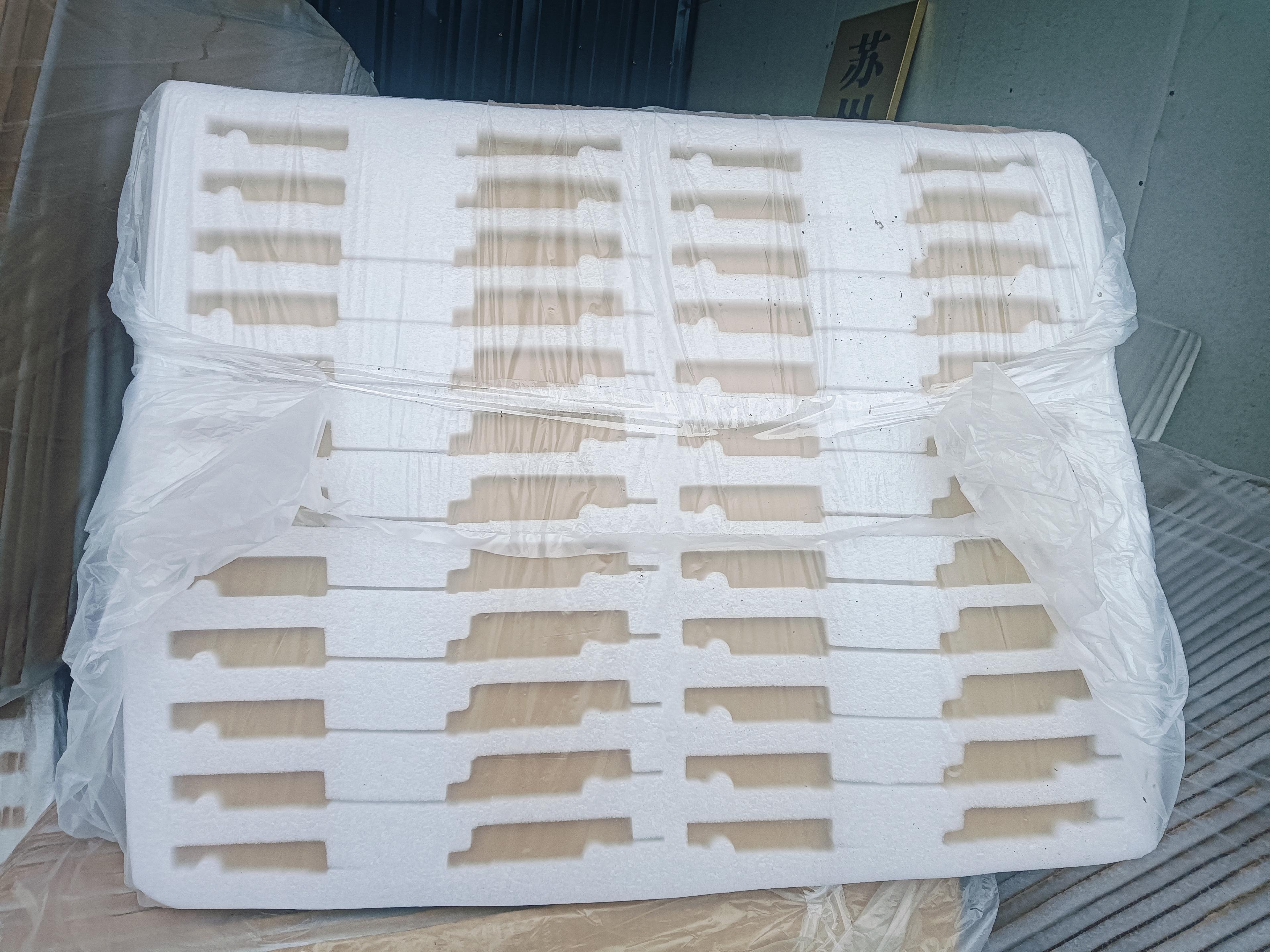
What these three foam components do in a packaging assembly
Blue layered foam strips, white foam board frames, and die-cut white foam trays are three distinct foam components that often appear in the same protective packaging assembly. They are not interchangeable. Each solves a different mechanical problem, and each carries its own specification and inspection requirements.
Blue layered foam strips are narrow, layered foam pieces used for cushioning and separation between components. White foam board frames are die-cut foam frames with repeated openings, used to hold components in position across a packaging layout. Die-cut white foam trays are formed foam trays with cavities shaped to arrange and position packaged items.
The practical consequence for buyers is that a single "foam packaging" request is rarely enough. A supplier needs the component geometry, the foam type, the intended load path, and the inspection criteria before it can quote or produce a part that performs as intended. The sections below explain the mechanism behind each component, the material and process choices that matter, the failure modes to watch for, and how to verify a shipment before it reaches your line.
Blue layered foam strips: construction and load path
Layered foam strips are built from multiple foam layers bonded or stacked into a strip profile. The layering is the defining feature: it lets the strip combine different foam densities or thicknesses in one cross-section, or build up a required thickness from thinner stock.
Why layering matters mechanically
A layered strip can distribute compressive load across the bond lines rather than through a single homogeneous block. In practice, this means the strip's cushioning behavior depends on the layer sequence, the bond quality between layers, and the orientation of the strip relative to the load. A strip loaded edge-on behaves differently from one loaded face-on, and a strip with a weak interlayer bond can delaminate under repeated vibration.
For procurement, the layer sequence is a specification item, not a manufacturing detail. If the drawing does not state layer order, thickness per layer, and bond requirement, two suppliers can produce strips that look identical but perform differently.
What to specify on a strip drawing
- Overall strip dimensions and tolerances, including length, width, and total thickness.
- Number of layers and thickness of each layer.
- Foam type and density per layer, if layers differ.
- Bond requirement between layers, stated as a performance expectation rather than a process name.
- Orientation marking so the strip is installed in the intended load direction.
- Cut finish: clean square ends versus compressed or torn ends.
The reference product evidence for blue layered foam strips lists cushioning and separation in packaging assemblies as the application, with shape and dimensions confirmed per order and a pre-shipment inspection aligned to the confirmed order specification. That is a process description, not a performance rating. Buyers should still request the actual dimensional and material data for their order.
White foam board frames and die-cut white foam trays: cavity geometry is the specification
Frames and trays are both die-cut foam components, but they serve different layout functions. A frame is a sheet with repeated openings; it holds components in a grid or pattern and is often stacked or combined with other layers. A tray has formed cavities that arrange and position items, usually with a base and sidewalls that contain the product.
Frame openings versus tray cavities
In a frame, the critical dimensions are the opening size, opening position, web width between openings, and the flatness of the sheet. In a tray, the critical dimensions are cavity depth, cavity draft or wall angle, base thickness under the cavity, and the position of each cavity relative to the tray edge.
Both are cut with a die, so the quality of the cut edge matters. A clean die-cut edge has minimal compression and no tearing. A poor cut leaves a ragged edge, a compressed lip, or foam dust that can contaminate the packaged product. For electronic and automotive components, foam dust is a real defect source, not a cosmetic issue.
Material choice for white foam components
White foam board and white foam tray stock are typically selected for a combination of cushioning, dimensional stability, and clean appearance. The reference product evidence does not name a specific polymer, so buyers should confirm the foam type, density, and thickness directly with the supplier for each order. Density affects compressive strength and cut-edge quality; thickness affects cavity depth capability and stack height.
A common procurement mistake is to specify color and shape but not density. Two white foam trays with identical cavity drawings can have different load-bearing capacity if the foam density differs. Ask for the density and the corresponding compression behavior in writing.
Comparison table: matching the component to the packaging problem
| Component | Primary function | Key specification items | Typical failure mode | Inspection focus |
|---|---|---|---|---|
| Blue layered foam strips | Cushioning and separation between components | Layer count and thickness, foam type per layer, bond quality, strip dimensions, orientation | Delamination between layers; compression set under sustained load | Layer bond integrity, dimensional check, cut end quality |
| White foam board frames | Holding components in a repeated opening pattern | Opening size and position, web width, sheet flatness, foam density, cut edge quality | Opening misalignment; web cracking; foam dust at cut edges | Opening position versus drawing, web integrity, edge cleanliness |
| Die-cut white foam trays | Arranging and positioning items in formed cavities | Cavity depth and draft, base thickness, cavity position, foam density, tray flatness | Cavity too shallow or too tight; base collapse under load; tray warping | Cavity dimensions, base thickness, flatness, fit check with sample part |
The table is a starting point, not a substitute for a drawing. Each row maps a component to the decision that most often causes a packaging failure in the field.
Measurable decision factors for engineers and procurement
When comparing quotes for these foam components, the lowest price per piece is rarely the lowest cost per protected unit. The following factors are measurable and should be part of the quote comparison.
Dimensional tolerance and fit
Ask each supplier to state the tolerance they will hold on cavity dimensions, opening positions, and strip thickness. A tight tolerance on a foam part is not automatically better: too tight and the part may not fit the product or the box; too loose and the product moves. The right tolerance comes from the product's allowable movement, not from a generic standard.
Foam density and compression behavior
Density is the most common hidden variable. Request the nominal density and, where the load path matters, a compression deflection value at a stated strain. If a supplier cannot provide this, treat the quote as incomplete for structural applications.
Cut quality and dust control
Die-cut foam generates dust. For electronic and automotive components, ask how the supplier controls dust after cutting: air cleaning, inspection under light, or packaging in a clean bag. This is a process question, and the answer should be specific.
Layout review before production
The reference product evidence states that packaging layout is reviewed against the requested component arrangement and that shape and dimensions are confirmed for each order. That review step is where most fit problems are caught. Buyers should ask for a layout confirmation drawing or a first-article sample before mass production, especially for trays with multiple cavities.
Common failure modes and how to catch them before shipment
Foam packaging failures tend to be quiet. A tray that is slightly warped or a strip that delaminates may pass a visual glance and fail in transit. The following failure modes are worth building into an inspection plan.
- Delamination in layered strips. Check by flexing a sample strip and inspecting the bond line. A strip that separates at the layer interface under light handling will not survive vibration.
- Compression set. Foam that has been stored under load can take a permanent set. Measure strip thickness on arrival against the drawing, not just at the supplier's dock.
- Cavity mismatch in trays. Fit a production sample component into the cavity. Check insertion force, lateral movement, and whether the component sits below the tray surface as intended.
- Web cracking in frames. Narrow webs between openings are stress concentrators. Inspect for cracks or whitening at the web corners.
- Warping. Place the tray or frame on a flat surface and check for rock or gap. Warped parts stack poorly and can misalign in automated packaging lines.
- Foam dust and loose fragments. Wipe a dark cloth across the cut edges. Visible residue indicates a cleaning step is needed.
These checks are simple and can be done at goods-in. They do not require a lab, but they do require a written acceptance criterion so that pass and fail are not a matter of opinion.
Supplier verification questions for foam packaging components
Because the reference evidence describes process commitments rather than published specifications, the buyer's job is to convert those commitments into verifiable order documents. The questions below are designed to do that.
- What foam type and density will be used for this order, and can you state it on the order confirmation?
- Can you provide a layout drawing for approval before cutting?
- What dimensional tolerances will you hold on the critical features, and how will they be measured?
- What does your pre-shipment inspection cover, and will you provide the inspection record with the shipment?
- How do you control foam dust after die-cutting?
- Can you supply a first-article sample for fit check before the full run?
A supplier who answers these questions in writing is easier to hold to a specification than one who answers verbally. The answers also give procurement a basis for comparing quotes on equal terms.
Limitations and scope of this guide
This guide describes the general construction and evaluation logic for blue layered foam strips, white foam board frames, and die-cut white foam trays. It does not state specific foam densities, compression ratings, flammability performance, or regulatory compliance for any product, because those values must come from the supplier's order-specific documentation. Standards and test methods vary by market and application; buyers should confirm which ones apply to their product and region before relying on any foam component in a safety-related or regulated application.
Where the reference evidence describes a process, such as layout review or pre-shipment inspection, treat it as a question to verify rather than a certified capability. The value of this guide is in the decision structure it gives you, not in a claim about any particular supplier.
Project discussion